

Five Signs You Have a Drain Emergency (Not Just a Slow Drain)
A customer called us on a Sunday evening last winter. The water in their kitchen sink had been draining slowly for a few days, and they had assumed it would sort itself out. It did not. By the time they rang, sewage was backing up into the shower tray in the bathroom below. What started as an inconvenience had become a health hazard in the space of forty-eight hours.
A slow drain is a warning. These five signs mean it has become an emergency: water is backing up into a sink, bath, shower or toilet rather than draining away; sewage or foul-smelling water is visible anywhere inside the property; more than one fixture is blocked at the same time, which points to a problem further down the shared line; there is gurgling coming from a drain you are not currently using, which means air is being pushed back through the system; or water is pooling around an outside gully or manhole and has nowhere to go.
Any single one of these is reason to call us now, not in the morning. Backed-up sewage carries bacteria, it creates pressure on older pipework, and it can reach electrical fittings and flooring within hours. Speed matters.
What Happens When You Call Dylex for an Emergency
When you call our emergency line on 086 014 3937, you speak to someone who can actually despatch an engineer. We are available around the clock, every day of the year, including bank holidays and Christmas Day. There is no answering machine at 3am.
We will ask you a few short questions: what the drain is doing, where the property is, and whether there is a manhole or inspection cover we can access on arrival. That last point matters. Clear access to the manhole means we can start work the moment we arrive. If the manhole is under decking or paving that needs lifting, let us know in advance so we can bring the right equipment and factor in the extra time. We will give you a price before any work begins. No hidden charges, no surprises when the invoice arrives.
Our target is to have an engineer with you within two hours of the call. In practice, across Dublin city and the surrounding counties, we usually get there faster during daytime hours. Once you agree to the quote, the van is already on its way.
On the Day: What the Engineer Actually Does
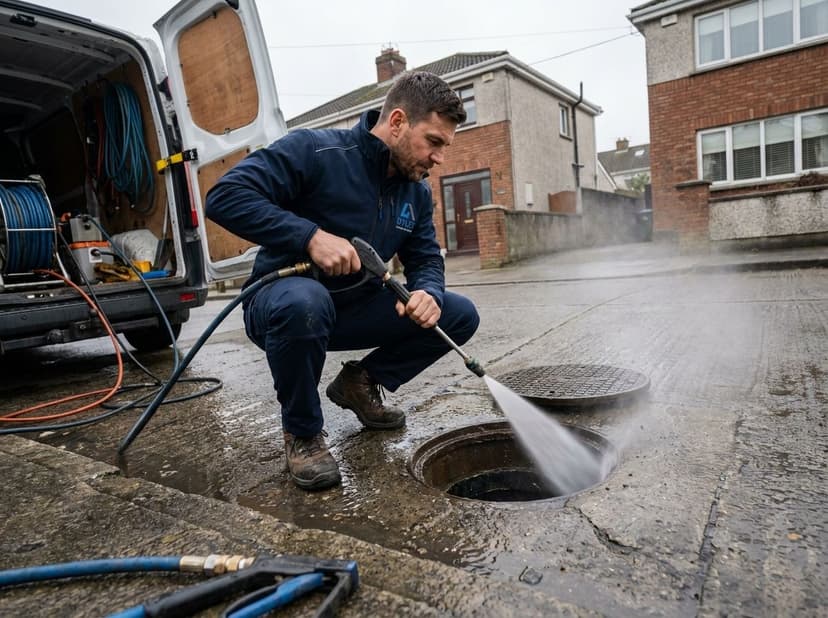
Every Dylex van carries high-pressure jetting equipment and a CCTV drain camera. That combination is deliberate. Most drainage companies send a jet first and ask questions later. We do not work that way.
The engineer arrives, locates the manhole or access point, and checks what is going on before any equipment goes into the drain. In most cases the blockage is identifiable immediately: a grease build-up in a kitchen waste line, a wad of wet wipes in a bathroom stack, a root intrusion in an outdoor run. The high-pressure jet then clears it. The whole process, from setting up to finishing, takes roughly an hour on a typical residential blockage.
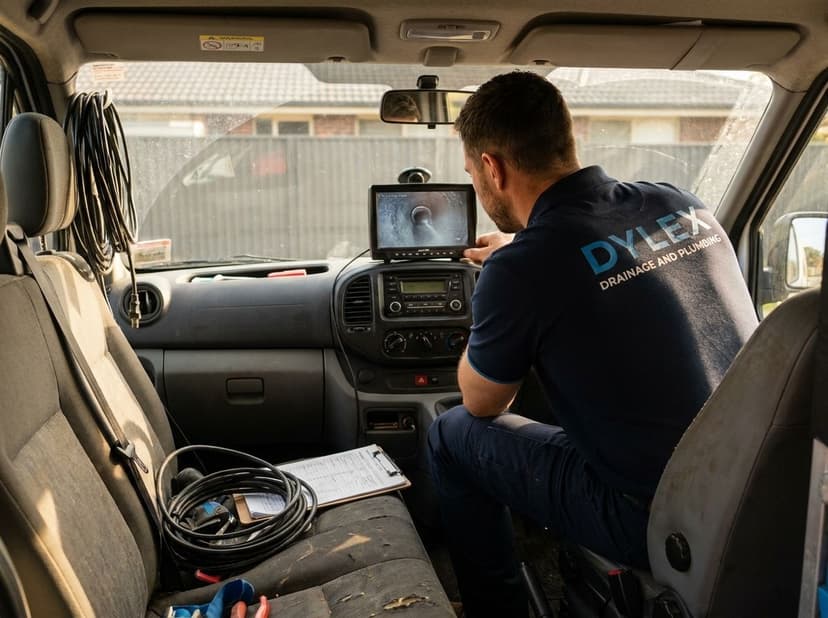
The CCTV camera comes out when the blockage is cleared or when the cause is not obvious from the surface. We run the camera through the pipe to see what caused the problem and to check the condition of the pipe around it. This is the step that separates a proper fix from a temporary one. If the cause is a crack, a collapsed section, or root damage that will re-block within weeks, we will tell you on the day and show you the footage. You then decide what to do next, with full information rather than guesswork.
Michael Cardiff, one of our customers, put it well after a recent callout: "Very professional and polite. Jason was here an hour after the call and got stuck in. I'm very happy with the work that was done." That is the standard we aim for on every job.
Payment is taken on the day by card. There is a card machine in the van. You receive a receipt before we leave the site.
Why Your Drain Blocked — and Why That Question Matters
Clearing a blocked drain is straightforward. Understanding why it blocked is what prevents you from calling us back for the same drain in three months.
The most common causes we find in Dublin homes and businesses are grease and fat accumulation in kitchen waste pipes, wet wipes and sanitary products in bathroom lines (they do not break down the way toilet paper does), tree root intrusion in older clay or concrete pipes, and structural issues such as cracked or misaligned joints that catch debris over time. In older properties, particularly Victorian and Edwardian terraces in Dublin city, collapsed sections of clay pipe are more common than most owners expect.
Once we know the cause, we can give you an honest assessment. A grease blockage cleared by jetting may need a maintenance plan if the property is a restaurant or busy kitchen. A root intrusion that has not yet caused structural damage can often be managed. A collapsed section needs a repair, whether that is a no dig repair using trenchless technology or a physical dig-up and pipe replacement. We will always recommend the right fix rather than the easiest one.
Emergency Drain Unblocking Costs in Dublin: The Real Numbers
Pricing for emergency drain unblocking in Dublin is rarely stated plainly online. Most companies use "from" figures that bear no resemblance to what appears on the invoice. Here is what we actually charge.
Emergency drain unblocking starts from €110 + VAT during standard working hours. Out-of-hours callouts, which means after 5pm on Saturday, Sundays and bank holidays, start from €170 + VAT. Those are the starting prices for a standard residential blockage. Commercial jobs, larger systems, or situations requiring extended jetting or camera work will cost more, and we will tell you that before we start.
There is no separate call-out fee. You pay for the work done, nothing else. If we attend and find that the blockage is not on your side of the pipe but in the public sewer main, we will tell you, explain the next step, and you are not charged for a fix we could not carry out. We hold ISO 9001 certification for quality management and ISO 14001 for environmental management, both of which mean our pricing and process are documented and consistent, not left to the engineer's discretion on the day.
For context, out-of-hours rates across the industry in Ireland typically run higher than daytime rates. The reason is straightforward: engineers working at 2am on a bank holiday carry an out-of-hours premium. We keep our rates as transparent as possible and publish them rather than asking you to "contact us for a quote" at the moment you need help most.
Is It Your Drain or Uisce Éireann's? How to Tell
This is one of the most common questions we get on an emergency call, and it is worth getting the answer right before you spend money.
In Ireland, Uisce Éireann is responsible for the public sewer network. Your responsibility as a property owner covers your internal plumbing and the private pipework running from your property all the way to where it connects to the public sewer main. Importantly, that private run includes the pipe outside your property boundary, under the garden, footpath or road, right up to the sewer connection. This is different from the position in England and Wales, where pipes outside the boundary transferred to water companies in 2011. In Ireland, that transfer never happened. The pipe is yours until it reaches the main.
Where several properties share a single drain before it connects to the public sewer, Uisce Éireann's published position is that all properties contributing to the flow share responsibility for a blockage in that shared section. It does not become a public-sewer problem simply by virtue of being shared.
A practical way to tell where the blockage sits: if only your property is affected, it is almost certainly on your private run. If neighbours are also backing up at the same time, the blockage may be in the shared section or in the public sewer itself. In that case, report it to Uisce Éireann on 1800 278 278. If the problem is on your side, call us. Our CCTV survey will locate the exact position of the blockage so there is no ambiguity about responsibility.
A CCTV drain survey from €250 + VAT will show you precisely where the problem is and produce a written report with footage. That report is also useful if you need to make an insurance claim or engage with Uisce Éireann about a boundary dispute on the pipe.
What to Do Before the Engineer Arrives
There are a few things you can do between making the call and our engineer arriving that will make the job quicker and cheaper.
First, locate your manhole or inspection cover. It is usually in the garden, driveway or just outside the front of the property. Clear anything sitting on top of it: plant pots, paving, decking panels. If it is under fixed decking that cannot easily be moved, let us know when you call so we can bring the right tools and price accordingly. If we arrive and find we need to lift permanent structures to access the drain, there is an additional charge for that work.
Stop using the affected fixtures if sewage is backing up. Running more water into a blocked system increases pressure and can push waste further into the property. Turn off the stopcock if water is actively leaking somewhere as a result of the blockage.
Make a note of what happened and when. Was it a sudden complete blockage or a gradual slowdown? Have you noticed any unusual smells in the days beforehand? Did several fixtures block at once or just one? This information helps the engineer diagnose the cause faster and is particularly useful if the problem turns out to be structural rather than a simple debris blockage.
Finally, make sure someone with authority to approve the work is present at the property. We provide the quote on arrival. We cannot begin until it is accepted, and we cannot take payment from someone who is not present. For commercial properties, confirm in advance that the keyholder or premises manager will be on site.
If you have a blocked drain right now, call our 24-hour emergency line on 086 014 3937. We cover Dublin, Kildare, Meath, Wicklow and surrounding counties, and our target is to have an engineer with you within two hours.